
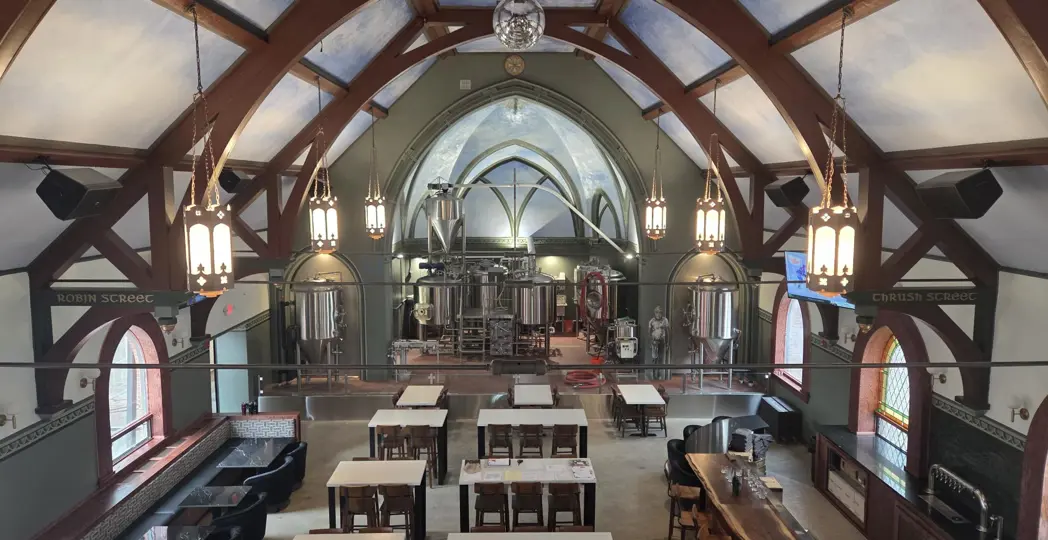
At the end of the church hall, where an ornate iconostasis once separated the congregation from the altar, shiny metal tanks now stand ready for fermenting and serving beer. Overhead, original pendant lights and a shimmering disco ball dangle from wooden ceiling beams. A former votive rack sits empty, with plans to be lit by electric candlelight.
When it opens in mid-April 2026, Birdtown Brewing will transform a historic Lakewood landmark into a new kind of gathering place—and cap a journey that began more than a decade ago.
From Divine Liturgy to Draft Beer
The stone building at 2035 Quail Avenue in Lakewood's Birdtown neighborhood was once St. Gregory the Theologian Byzantine Catholic Church, a Ruthenian parish formed in 1905 and formally erected in 1906. For nearly 100 years, it served Birdtown's Eastern European Catholic community with its golden onion dome, vibrant stained glass, and Byzantine iconography. The church held its final Divine Liturgy in December 2011 and was sold in 2014. Plans for Birdtown Brewing followed soon after—but the path to opening would stretch another 12 years.
"It's been a long, arduous process," general manager Ryan Grammerstorf told Cleveland Magazine, "but we've been taking our time because we want this to be done right."
The extensive renovation preserves the building's character while creating multiple pub-styled areas: a bar along the main beer hall, an upstairs mezzanine for private events, a brand-new kitchen, a downstairs overflow area with pinball and vintage video games, and a patio for warmer months. The former iconostasis now frames the brewing equipment—a visual bridge between sacred past and communal present.
Ohio's Church-to-Brewery Wave
Birdtown Brewing is not the first Ohio brewery to occupy a former place of worship. The state has emerged as a hub for this adaptive reuse trend. Ohio Magazine lists five such breweries, including Bell Tower Brewing in Kent (opened 2021 in the former First Congregational Church, built 1858), Urban Artifact in Cincinnati's Northside (operating since 2015 in the former St. Patrick's Church, a National Historic Landmark), Noble Creature Wild Ales & Lagers in Youngstown, Holy Moley Brewing Co. in Dennison, and Father John's Microbrewery in Bryan.
Nationally, AP News and The Columbian report that roughly 30 breweries operate in former churches across the U.S., with at least eight additional conversions since 2020. Churches offer high ceilings, distinctive architecture, and large open spaces—ideal for brewing equipment and crowds. As Tasting Table notes, the partnership between beer and sacred spaces has deep roots: Benedictine monks began brewing beer over 1,500 years ago, inventing the use of hops as a preservative. Modern church-based breweries echo that monastic tradition of beer as sustenance and community.
Easy-Drinking Ales and Lagers
Head brewer Zach DelPriore, formerly of Platform Brewing Co. and Market Garden Brewery, will pour eight to 12 brews on tap at all times—focusing on traditional ales and lagers rather than experimental one-offs.
"It's no secret that people are drinking less now, and you're seeing that people already know what they want," DelPriore told Cleveland Magazine. "Trends are changing. It's not about trying as many crazy things anymore. Lagers are coming back, and people want more consistency and a better product."
That philosophy aligns with broader industry shifts toward approachable, sessionable styles—a theme BrewLedger has tracked in the lager resurgence and portfolio rationalization among craft breweries.
Geraci's Pizza and Pub Fare
Food comes from Geraci's, the 70-year-old family-owned pizzeria founded in 1956 by Frances and Michael Geraci. As cleveland.com has documented, Geraci's pioneered carry-out pizza in Northeast Ohio and has served over a million pizzas using family recipes passed down from Sicily. The Birdtown menu leans on Geraci's crowd favorites while adding pub-style items—burgers, wings, sandwiches—and vegan and vegetarian options to match Lakewood's diverse, health-conscious community.
"We want to try to make everybody happy," Grammerstorf said.
Birdtown's Revitalization
Birdtown Brewing enters a neighborhood that has transformed since plans first launched. Cleveland Magazine and The Land describe Birdtown as an older neighborhood dating to the 1890s that developers view as ripe for redevelopment. Madison Avenue has become a Lakewood going-out destination, with openings like Birdietown, Amazonia, Winchester Music Tavern, The Roxy, and LBM in the past decade. Birdietown (the mini-golf and lounge venue) opened in the historic Bi-Rite building in January 2025, and The Nest—a $4–5 million mixed-use development with 18 apartments and storefronts—is under development at 12501 Madison Avenue.
"When we purchased it, there really wasn't much over here. As soon as we made that announcement, I feel like Birdtown flipped the switch, and now it's an incredible place," Grammerstorf said. "All these new businesses going in along Madison revitalized this whole area, and we're super happy to be a part of it."
Birdtown Brewing sits one block from Madison, in the heart of a residential neighborhood and across from Harris Elementary School—positioning it as a neighborhood anchor rather than a Madison Avenue corridor project.
Synthesis: Patience, Place, and the Second Life of Sacred Spaces
What Birdtown Brewing illustrates is a pattern: the best church-to-brewery conversions succeed when they honor both the building and the neighborhood. They preserve architectural character (stained glass, iconostasis, vaulted ceilings) while adding new layers of meaning—community gathering, local employment, and neighborhood identity. The 12-year delay, while frustrating, may have been a blessing: Birdtown is now a different place than it was in 2014, with a more vibrant commercial corridor and a clearer appetite for neighborhood-focused breweries.
The partnership with Geraci's—a family-owned institution with decades of Cleveland history—reinforces that sense of place. So does DelPriore's focus on approachable lagers and ales: in a crowded craft market, consistency and drinkability often outperform novelty.
Birdtown Brewing opens in mid-April 2026, as the stone building enters its 101st year. Raise a glass to patience, adaptive reuse, and the second life of sacred spaces.
Operational discipline matters when you're opening a new brewery and managing inventory across multiple tap lines. BrewLedger helps craft breweries track inventory, batches, and production—see how it works when you're ready.