

Arthur Guinness is one of the most consequential figures in the history of beer. Born in rural County Kildare in 1725, he would go on to found a brewery at St. James's Gate in Dublin that, more than 265 years later, remains one of the world's most recognizable brands. The black stout that bears his name is drunk in nearly every country on earth. The Guinness Storehouse at St. James's Gate is Ireland's most visited tourist attraction. And the 9,000-year lease he signed on December 31, 1759—a document that has come to symbolize his faith in the enterprise—has entered brewing folklore. But Arthur Guinness was far more than a brewer. He was a philanthropist, a political advocate, a devout Protestant who championed Catholic rights, a family man who raised ten children, and a fighter who once confronted Dublin Corporation with a pickaxe when they threatened to cut off his water supply. His story is the story of how one man's vision, persistence, and belief in quality built an institution that outlasted empires. For anyone in the brewing industry—whether running a taproom, a regional craft brewery, or a legacy operation—Arthur Guinness offers a masterclass in long-term thinking, adaptation to market shifts, and the kind of stubborn conviction that turns a small lease into a global phenomenon.
Early Life: Celbridge and the Price Connection
Arthur Guinness was born in Clonoughlis, near Celbridge in County Kildare, most likely on September 24, 1725—though the exact date has been disputed. His gravestone records that he was 78 when he died in January 1803, which would place his birth in 1724. The Guinness Company itself has at times given September 28 as his birth date. What is certain is that he was the first of five children born to Richard Guinness and Elizabeth Read. His father worked for Arthur Price, a vicar in Celbridge who would later become Archbishop of Cashel—one of the most prestigious positions in the Church of Ireland. Arthur Guinness was named for Price, who also served as his godfather. That connection would prove decisive.
Little is known with certainty about Arthur's ancestry. During his lifetime, he believed he was descended from the Magennises of Iveagh, a Gaelic Catholic noble family. DNA testing conducted by Trinity College Dublin in the 21st century, however, suggests his ancestors were more likely the McCartans of County Down, from a village called Guiness near Ballynahinch. Whatever the lineage, Arthur grew up in a world where beer was central to Irish life. His maternal grandfather, William Read, had applied for a licence to sell ale in 1690, which he likely brewed himself and sold at a stall on the Dublin–Cork road. Beer was brewed in homes, on estates, and in public houses across the island. The craft was everywhere.
In August 1742, when Arthur was about 17, his mother died at 44. That same year, he followed his father into work for Arthur Price, serving as a registrar—a role that required literacy, arithmetic, and the ability to write. Such skills were rare for non-nobles and would serve him well. In 1744, Price was appointed Archbishop of Cashel, a promotion that came with a substantial pay raise for his staff. The Guinness family remained in Price's employ until the archbishop's death on July 17, 1752. In his will, Price bequeathed £100 each to Arthur Guinness and his father. That £100—roughly £20,000 in today's money—would become the seed capital for a brewery.
The White Hart, Leixlip, and the First Brewery
On October 19, 1752, Richard Guinness married his second wife, Elizabeth Clare, a widow who had taken over the White Hart Inn after her first husband's death. Arthur and his siblings went to work at the public house. It was there, historians believe, that Arthur learned the practical craft of brewing—mashing, fermenting, and serving beer to customers. The yeast he would later use at St. James's Gate may have originated from the White Hart. Beer was not just a commodity; it was a way of life, and Arthur was immersed in it. The Oakley Park estate where Price had lived featured a malt house and brewery—well known in Kildare for its porter—though it was listed as the property of Jasper Carbery rather than Price himself. Whether Arthur had direct involvement in that operation is unclear, but the atmosphere of brewing was all around him. His father managed Price's estate and its various responsibilities; his stepmother ran a pub. The path from £100 inheritance to brewery owner was not a straight line, but it was a logical one for a young man who had learned to read, write, and reckon, and who had been steeped in the culture of beer from childhood.
In September 1755, Arthur Guinness acquired his first brewery—a three-story building in Leixlip that ran from the street to the River Liffey. The river provided water for brewing and power. Barley came from neighboring farms; hops could be brought from Dublin along the main Dublin–Galway road. For four years, Arthur brewed in Leixlip, building his reputation and his skills. He left the operation in the care of his brother Richard when he moved to Dublin in 1759.
That move coincided with a financial crisis. The Seven Years' War had caused economic upheaval across Europe. Banks in Ireland collapsed. Property in Dublin became cheap and abundant. Arthur Guinness had his eye on a particular site: an abandoned brewery at St. James's Gate that had lain unused for nine years. The property belonged to the Rainsford family, descendants of Mark Rainsford, who had run a brewery there decades earlier. The site covered four acres and included a brewhouse, a gristmill, two malt houses, and stables. It was also strategically located: Ireland was building its Grand Canal, which was intended to terminate just outside St. James's Gate, promising easy transport for raw materials and finished beer.
On December 31, 1759, Arthur Guinness signed a lease that has passed into legend. He paid £100 down and agreed to £45 per year for 9,000 years. The length of the lease was not unusual for the era—long leases were common as a way to secure favorable terms—but the number has come to symbolize something larger: Arthur's belief that the enterprise would endure. As Guinness's own website puts it: "If that's not belief, we don't know what is."
The Water War and the Pickaxe
The lease granted Arthur use of a limited supply of water from the city. As the brewery grew, so did its water needs. By 1773, Dublin Corporation claimed that Guinness was using more water than his lease allowed. Guinness argued that the terms afforded him water "free of tax or pipe money." The dispute escalated. In April 1775, the corporation discovered that Guinness had altered his pipe system to draw more water onto his property. They elected to physically cut off his supply.
Arthur Guinness did not back down. According to accounts passed down through the Guinness family and recorded in company lore, he "violently rushed upon them wrenching a pickaxe from one and declaring with very much improper language, that they should not proceed." He threatened to dig his own channel to the water source. The matter went to court, and in 1785, a settlement was reached: Guinness would lease water from the City of Dublin for £10 per year. The brewery's supply was secure. Arthur had fought for his enterprise and won. The incident illustrates a trait that would define him: he was willing to confront authority when he believed he was in the right.
From Ale to Porter: The Pivot That Built an Empire
When Arthur Guinness took over St. James's Gate, the brewery produced ale. Dublin's drinkers, however, had developed a taste for porter—a dark, hearty beer that had become popular in London and was being imported from England in large quantities. Irish brewers were at a disadvantage: domestic porter was taxed at a rate more than five times higher than imported English beer. The Irish brewing industry was struggling.
Guinness began tentatively adding porter to his output in 1778. By 1783, it dominated his marketing. He told a parliamentary committee that "a porter buys none but the best, as none else will answer." A memoranda book from 1796 shows that porter production at St. James's Gate was by then five times larger than ale output. On April 22, 1799, Arthur Guinness brewed his last ale. Henceforth, St. James's Gate would be a porter brewery.
He also innovated. His "West India Porter"—brewed with extra hops and higher alcohol to survive the long sea journey to the Caribbean—would become the basis for Guinness Foreign Extra Stout, which remains one of the brand's flagship products in Africa, Asia, and the Caribbean. Export was on his mind from the start. The first documented export of Guinness to England occurred in 1796, when six and a half barrels were shipped. Within decades, Guinness would be drunk on every continent. The West India Porter formula—higher alcohol, more hops for preservation—would prove crucial as the British Empire expanded. Ships carrying Guinness to the Caribbean, Africa, and Asia needed a beer that could survive months at sea. Arthur had anticipated that need. The same beer that Dublin's porters and laborers drank in the 1780s would, in modified form, become the Guinness that Nigerians, Jamaicans, and Singaporeans would embrace. Export was not an afterthought; it was part of the original vision.
Arthur was not immediately the dominant brewer in Dublin. Tax records from 1766 show he was still outpaced by rivals such as Taylor, Thwaites, and Phepoe. But he was politically active on behalf of the industry. As warden and later master of the Dublin Corporation of Brewers, he petitioned the Irish House of Commons to change the tax code. In 1777, amid the fiscal chaos of the American Revolutionary War, the House of Commons finally altered the policy. Irish porter would no longer be taxed at a rate that subsidized English imports. The change created a market for Irish porter in England and made beer exportation a staple of the Irish economy. Two years later, Guinness became the official beer purveyor of Dublin Castle—a prestigious appointment that signaled his rising stature.
The historic St. James's Gate Brewery in Dublin, where Arthur Guinness signed his legendary 9,000-year lease in 1759. The site remains the spiritual home of Guinness and houses the Guinness Storehouse, Ireland's most visited tourist attraction.
Family, Faith, and Philanthropy
On June 17, 1761, Arthur Guinness married Olivia Whitmore, a woman from a wealthy and well-connected family who brought a £1,000 dowry. She was a descendant of William of Wykeham and a cousin of Henry Grattan, the Irish statesman who argued for Catholic rights and legislative independence. The marriage elevated Arthur into the gentry and connected him to influential political circles. Olivia suffered 11 miscarriages but gave birth to ten children, nine of whom survived into adulthood: four daughters and six sons. Their names—Elizabeth, Hosea, Arthur, Edward, Olivia, Benjamin, Louisa, John Grattan, William Lunell, and Mary Anne—would populate the next century of Guinness history.
Arthur was a deeply religious man. His personal motto was Spes Mea in Deo—"My Hope is in God." He never converted to Methodism but remained in the Church of Ireland; his diaries suggest his faith was influenced by John Wesley and the Methodist model of evangelical social work. In 1786, he opened the first Sunday school in Dublin, inspired by Robert Raikes's belief that early education in faith and morals could reduce crime. He served as treasurer and later Governor of Meath Hospital, donated to St. Patrick's Cathedral, and gave 250 guineas to the Chapel Schools attached to the cathedral.
He believed that the wealthy had a duty to set a strong moral example. He once protested the traditional feast held when a new alderman took office, fearing it would lead to drunken impropriety, and suggested the money be donated to The King's Hospital instead. He opposed duelling among the Irish elite, which he viewed as deadly sport masquerading as honour. He supported penal reform, arguing against excessive punishment. Yet he never embraced teetotalism; like his fellow brewers, he believed drunkenness was caused by liquor, not beer.
His political positions were complex. He supported Catholic rights—hiring Catholics at his brewery, advocating for laws that would allow Catholics to enter professions, and arguing for economic development that would benefit lower-class Catholics. He was a member of the Kildare Knot, a dining club that included the Irish Volunteers, a militia formed to defend Ireland from potential French invasion. But he opposed the Irish Rebellion of 1798, a Presbyterian-led uprising against British rule. He disliked the economic disruption and the violence; his son John was wounded in the fighting. Irish nationalists would later deride his beer as "black Protestant porter." Arthur Guinness was a man of principle, but his principles did not always align with a single political camp.
Later Years and Legacy
In 1764, the Guinness family moved to Beaumont House, an estate north of Dublin. Arthur continued to expand the brewery. By 1790, two flour mills in Kilmainham—the Hibernian Mills—were operational. Production soared: in 1796, St. James's Gate produced 198,000 pints per month; by the time of Arthur's death in 1803, that figure had reached 724,000. The transition from ale to porter had transformed the business.
Arthur Guinness died on January 23, 1803, at Beaumont House, of unknown causes. His funeral bier, adorned with the Magennis family crest, carried his remains to the parish church at Oughter Ard in County Kildare, where he was buried beside his mother. The funeral was presided over by his son Hosea, who had entered the clergy rather than the family business. The inscription on his gravestone reads: "In the adjoining Vault are deposited the mortal remains of Arthur Guinness late of James's Gate in the city and of Beaumont in the County of Dublin Esquire who departed his life on the 23rd of January 1803 aged 78 years." The Dublin Evening Post wrote: "The worthy and the good will regret him because his life has been useful and benevolent and virtuous."
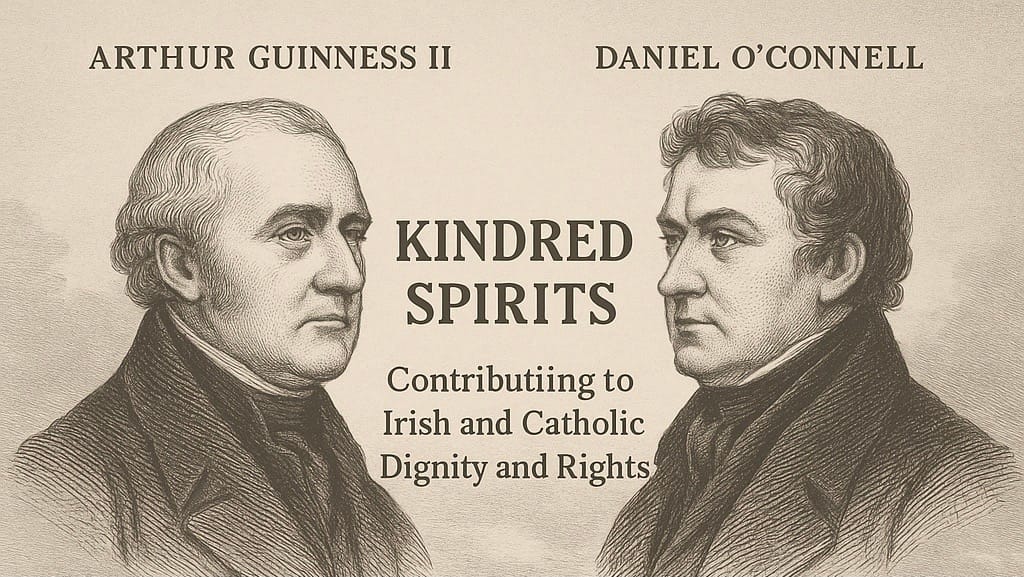
His estate was valued at £23,000. In his will, he left Beaumont and his investment properties to Hosea. The brewery passed to his son Arthur Guinness II, who would be assisted by his brothers Benjamin and William. In 1808, the company was renamed Guinness (A., Ben & W.L.) brewers. The dynasty had begun.
The Enduring Brand
What Arthur Guinness built has endured in ways he could not have imagined. By 1838, Guinness was Ireland's largest brewery. By 1886, it was the world's largest. The Guinness Storehouse, opened in 2000 in part of the St. James's Gate complex, has welcomed more than 20 million visitors and is Ireland's most popular tourist destination. In 1997, Guinness PLC merged with Grand Metropolitan to form Diageo, one of the world's largest beverage companies. Guinness remains a crown jewel in that portfolio, with the brand generating billions in annual sales.
The philanthropic tradition Arthur began continued for seven generations. Sir Benjamin Lee Guinness, his grandson, donated £150,000 toward the restoration of St. Patrick's Cathedral and served as Lord Mayor of Dublin. Edward Cecil Guinness, the first Earl of Iveagh, established the Guinness and Iveagh Trusts to provide housing for the poor in London and Dublin. Arthur Edward Guinness purchased St. Stephen's Green and donated it to the city so the park could be enjoyed by everyone. The company pioneered employee welfare—paying 10% above the average industrial wage, establishing a medical centre, offering paid holidays, free meals, and a pension scheme. The Arthur Guinness Fund, established in 2009 for the 250th anniversary, continues to support social entrepreneurs.
In 2009, Diageo declared September 24 "Arthur's Day," a worldwide celebration of the brewer's life. The festival ran for five years before being discontinued, but the legacy remains. Ireland's An Post has issued commemorative stamps. The "Arthur's Way" heritage trail connects locations important to Guinness in Dublin, Celbridge, Leixlip, and Oughter Ard. A statue of Arthur stands in Celbridge.
Why Arthur Guinness Matters
Arthur Guinness matters because he built something that outlasted him—not just a brand, but a way of doing business. He combined entrepreneurial vision with civic responsibility. He fought for his enterprise when it was threatened. He adapted when the market shifted from ale to porter. He advocated for his industry and for the rights of others. He believed that quality mattered—"a porter buys none but the best"—and he was willing to bet 9,000 years on it. The brewery he founded would go on to pioneer quality control at a scale few could have imagined: in the 1890s, Guinness sent inspectors around the world by steamship to verify that the beer was being shipped, stored, and served correctly. From Sydney to Boston to Singapore, these men risked stormy seas to ensure that every pint met the standard. That obsession with quality began with Arthur. He did not brew for the cheapest market; he brewed for the one that would pay for the best.
The story of Arthur Guinness is a reminder that the greatest brands are built by people who refuse to settle. He signed a lease that seemed absurd. He confronted a city government with a pickaxe. He pivoted his entire operation from ale to porter when the market demanded it. He raised ten children, opened the first Sunday school in Dublin, and became the official brewer to Dublin Castle. He was a man of faith, a man of principle, and a man who understood that building something lasting requires both conviction and flexibility.
Every pint of Guinness poured today is a continuation of that legacy. The black liquid in the glass connects the drinker to a man who, in 1759, looked at an abandoned brewery and saw a future. The harp on the glass—the same symbol that appears on the Irish passport, though facing the other way because Guinness trademarked it first—traces back to Arthur's insistence that his beer be recognized as Irish, as quality, as something worth defending. The ritual of the two-part pour, the creamy head, the nitro surge: all of it descends from decisions made in a brewhouse on the banks of the Liffey more than two and a half centuries ago. Arthur Guinness could not have foreseen TikTok, or the G-splitting phenomenon, or a world in which his name would be spoken in every language. But he understood something fundamental: that building something lasting requires conviction, adaptation, and a willingness to fight for what you believe in. Sláinte, Arthur.
Sources: Wikipedia – Arthur Guinness; Guinness – The Story of Guinness; Guinness Storehouse – Discover the Story of Guinness; The Irish Post – Remembering Arthur Guinness.
Operational discipline and brand stewardship both matter. BrewLedger helps craft breweries track inventory, batches, and production—see how it works when you're ready.